Introduction
Ask ten training managers what e-learning means and you’ll get ten different answers. For some, it’s a deck of slides with a next button. For others, it’s a fully interactive course with filmed demonstrations, 3D animations, and scenario-based decision making. Both get called e-learning, but they don’t deliver the same results, and they don’t cost the same to build.
Before we get to the five reasons video-based training belongs in your e-learning, it’s worth being clear about what separates the basic courses from the ones people actually remember. The industry has a useful framework for this, and it explains why video sits at the heart of the most effective training being built today.
Not all e-learning is built the same
Instructional designers commonly sort e-learning into four levels of interactivity. The framework traces back to the US Department of Defense’s handbook on the Development of Interactive Multimedia Instruction (MIL-HDBK-29612-3A), published in 2001, which defined the levels as passive, limited participation, complex participation, and real-time participation. The training industry has adapted the labels over the years, but the ladder itself hasn’t changed: each level asks more of the learner than the one before it.
Level 1: passive e-learning. This is the slide deck dressed up as a course. Text, static images, maybe a short quiz at the end. In the original handbook’s terms, the learner acts purely as a receiver of information, and their only real interaction is clicking forward or back, which is why these courses get called “page-turners.” They’re cheap and quick to produce, and they’re fine for simple policy acknowledgments. They’re also the courses people click through with the sound off.
Level 2: limited interactivity. Here you’ll find voiceover narration, basic 2D animations within slides, clickable menus, drag-and-drop exercises, and question-and-answer sections scattered through the module. The handbook describes this as the learner making simple responses to instructional cues, with feedback guiding them when they get it wrong. Most off-the-shelf compliance training lives at this level.
Level 3: moderate interactivity. The handbook calls this complex participation, and courses at this level start to feel customized. Animated video sequences, personalized audio, richer multimedia, and branched scenario questions, where a wrong choice sends the learner down a different path with its own feedback, give learners genuine control over how they move through the material.
Then there’s the fourth level, which deserves its own section.
Hyper-interactive e-learning: the fourth level
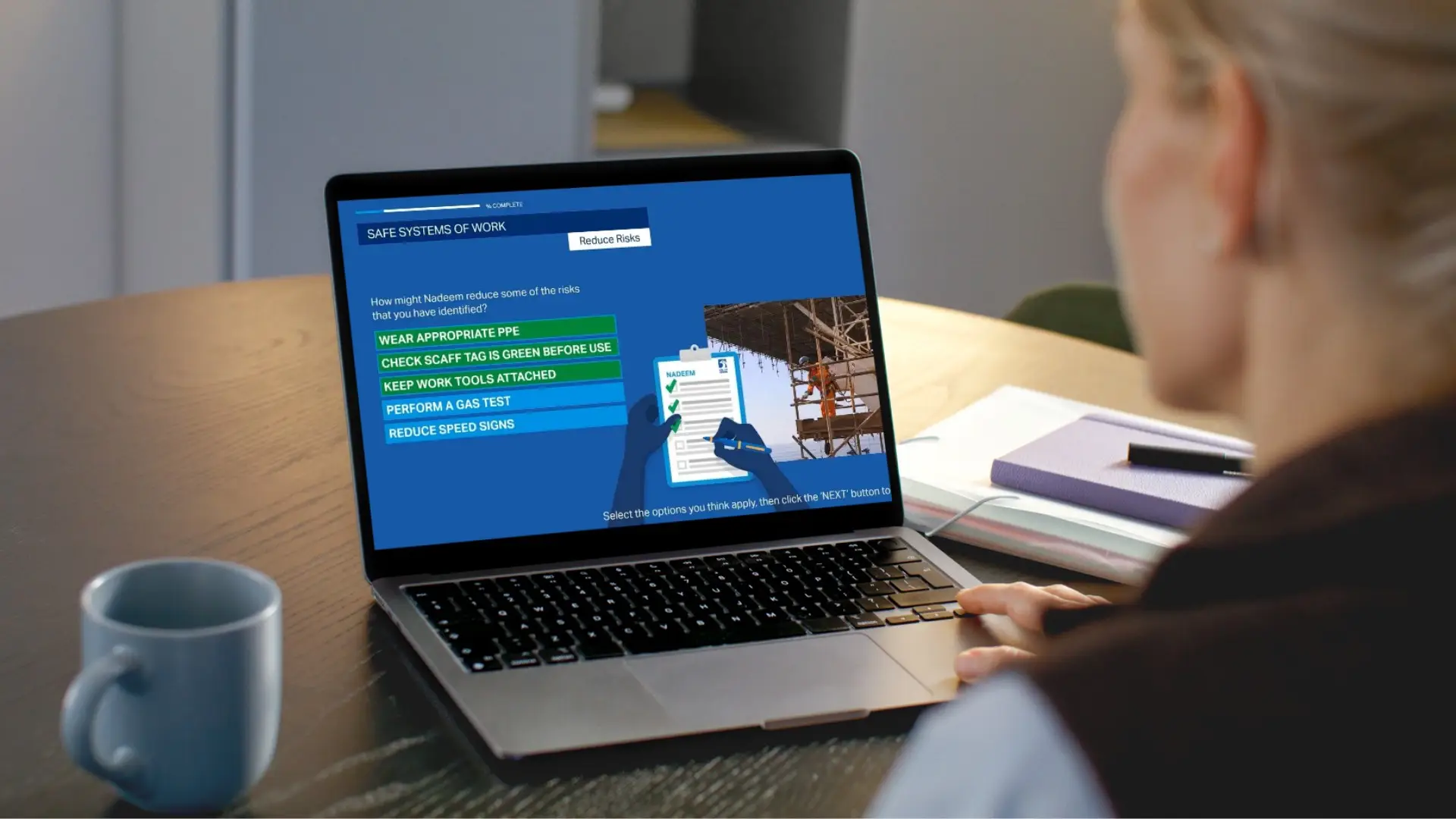
Level 4 is where e-learning stops resembling a presentation and starts resembling an experience. The original DoD handbook defined it as real-time participation, where the learner works through a life-like set of cues and responses that mirrors the actual job. Hyper-interactive e-learning. These courses take a blended learning approach, combining rich media the learner can manipulate, professionally produced video, 3D animations of equipment and environments, simulations that let learners practice decisions in a consequence-free setting, and extended branching scenarios that play out inside realistic environments rather than as isolated quiz questions. A learner might watch a filmed safety demonstration, rotate a 3D model of the valve assembly they just saw, then work through a branching scenario that mirrors a real shift on site.
The blended learning approach behind this is straightforward in principle. No single format teaches everything well, so you combine formats deliberately. Video carries demonstration and storytelling, while 3D animation reveals what a camera can’t reach, like the inside of a pump or the failure point in a weld. Interactive exercises then confirm the knowledge stuck. Some programs also blend in instructor-led sessions, whether in a classroom or a virtual one, so the digital content prepares learners for richer face-to-face practice.
This is also where the money in the industry is going. If you follow reported e-learning statistics, a pattern emerges. Organizations are shifting spend away from generic content libraries and toward blended programs and custom-built courses. Training magazine’s most recent Training Industry Report, its annual survey of US organizations, put total training expenditure at $102.8 billion in 2025, with spending on outside products and services, the category that includes custom content development, surging 29% in a single year to $16 billion. The same report found blended learning accounted for 22% of all training hours delivered. On the market side, The Business Research Company’s Blended Learning Global Market Report puts the blended learning market at $31.51 billion in 2026, up 12.7% on the year before, though it’s worth noting that market sizing varies considerably between research firms because each defines the category differently.
Whichever figures you trust, the direction is the same. Buyers have seen what page-turners deliver, and they’re paying for something better. Video is the backbone of that shift, and here’s why it earns its place.
1. Learners prefer video, by a wide margin
Given the choice, workers ask for video training. TechSmith’s Video Viewer Study, a survey of 1,000 participants across the US, UK, Canada, Australia, France, and Germany, found that 83% of respondents said they prefer consuming instructional or informational content as video. Fewer than half said the same about text (41%) or audio (30%). TechSmith’s 2026 video statistics roundup confirms that preference has held steady since. The same study found training videos, live streams, and webinars made up roughly half of all the video content respondents watched. When your workforce already turns to video to learn how to fix a tap or configure software at home, handing them a wall of bullet points at work feels like a step backward.
Inside an e-learning course, that preference translates directly into completion. A module that opens with a well-produced video meets learners in a format they’ve chosen thousands of times on their own. It lowers the resistance to starting, which is half the battle with mandatory training, and it sets an expectation of quality that carries the learner through the interactive exercises that follow. The video earns their attention; the rest of the course puts it to work.
2. Video holds attention in ways slides can’t
Attention is the scarcest resource in workplace training, and video is measurably better at holding it, provided it’s produced with intent. The largest study of educational video engagement to date, published by Guo, Kim, and Rubin at the ACM Learning at Scale conference, analyzed 6.9 million video watching sessions on the edX platform. Its findings read like a production brief. Shorter, purpose-made videos held attention far better than long ones, and informal talking-head footage outperformed polished lecture recordings. Repurposed classroom lectures made for poor online viewing no matter how they were edited. In other words, the engagement advantage belongs to video that’s designed for the screen it’s watched on, which is exactly what custom production delivers.
Within an e-learning course, these short, focused videos become pacing devices. Instead of forty minutes of continuous slides, the learner moves through a rhythm. A two-minute video introduces a hazard, then an interactive exercise tests their response to it. Each format resets attention before fatigue sets in. The course stops feeling like a document to endure and starts feeling like a sequence worth following.
3. Video shows the job instead of describing it
Some knowledge resists text entirely. You can write four paragraphs on the correct technique for breaking containment on a flanged joint, or you can film a competent technician doing it in ninety seconds, with the camera angle chosen to show hand position and the exact moment where inexperienced workers usually go wrong. For physical, procedural work, the kind that dominates energy, construction, and manufacturing, video captures nuances that written instructions flatten, like body positioning or the sound a machine makes when something’s off. Filmed on your actual site with your actual equipment, it also teaches the environment, so a new starter’s first day on the plant floor isn’t their first look at it.
Paired with e-learning, demonstration video becomes the “watch” in a watch-then-do loop. The learner sees the procedure performed correctly, then the course immediately asks them to apply it, whether by sequencing the steps or spotting the deliberate error in a second clip. That immediate application is something a standalone video can’t offer and a text-only course can’t set up convincingly. Together, they turn observation into rehearsal.
4. Video improves outcomes when it’s built into the curriculum
Beyond preference and attention, there’s evidence that video improves what learners actually walk away with. A longitudinal study published in Humanities and Social Sciences Communications, a Nature Portfolio journal, tracked students across multiple academic years as video-based learning was progressively integrated into a taught business statistics curriculum. The researchers found measurable benefits to achievement from the video-based approach, and something else worth noting: learners tended to use video alongside other resources rather than instead of them. Video did its best work as reinforcement woven through the curriculum.
That finding is really an argument for blended e-learning. Video delivers its full value when it’s woven into a structured course, with assessments confirming comprehension and the learning management system tracking who’s completed what. A video library on its own is a resource people may or may not use. A video embedded in a designed learning journey is a checkpoint every learner passes through, with the data to prove it.
5. Video standardizes training across every site and shift
Instructor-led training varies with the instructor. The Tuesday morning session and the Thursday night one cover the same syllabus and deliver different courses, because trainers emphasize different points and have different good days. Video removes that variance. Every learner on every site watches the same demonstration performed the same way, reviewed and approved by your subject matter experts before a single employee sees it. For safety-critical procedures, that consistency is the entire point. And when a procedure changes, you update one video instead of rebriefing every trainer in the business.
E-learning is what makes that consistency operational. The course wraps your standardized video content in enrollment tracking and assessment, so you can prove that every worker watched the current version of the procedure and passed the check that followed. When an auditor or regulator asks how you know your training is consistent across sites, a blended e-learning program answers with records rather than assurances.
How to improve your e-learning with video cost-effectively
Video has a reputation for being the expensive part of e-learning, and it can be, if it’s bolted on as an afterthought. The way to keep costs down is to plan video at the design stage rather than after the course is scoped. When the shoot is planned around the course structure, a single day of filming can feed a dozen modules. The full demonstration becomes the core lesson, and individual steps become microlearning clips, with the near-miss footage held back as assessment material. Compare that with commissioning one standalone video per module and the economics shift dramatically. The same logic applies to 3D assets. A model of your equipment built once can be reused from induction through to refresher training for years, and updated for a fraction of what a reshoot would cost when a procedure changes.
Where those savings most often leak away is between suppliers. When the video team and the e-learning team work for different companies, you inherit the seams: mismatched visual styles, duplicated project management, footage shot without knowing how the course will use it, and two sets of invoices for work that overlaps. The best e-learning providers have expertise across all facets of the work, so your filmed content, your 3D animations, and your course development come from a single source. One team plans the shoot around the course, and one visual style runs through everything the learner sees. A single point of contact keeps the project streamlined. That’s how video scales across an e-learning program without the budget scaling with it.