Why are companies using VR training?
The commercial pull behind virtual reality training is easy to understand. Grand View Research values the global immersive training market at $16.4 billion in 2024, with growth of 28.3% a year expected through to 2030. Behind that number sits a simple operational reality, which is that the tasks most worth training on are often the ones you can least afford to practice for real.
PwC’s research on VR effectiveness gives a sense of why it works. In their study, learners in VR completed training four times faster than their classroom counterparts, felt considerably more confident applying what they’d learned, and were four times more focused than people working through the same material as e-learning. Cost is the other half of the story, and it’s where the return on investment case gets made. Virtual reality reached parity with classroom delivery at 375 learners, and by 3,000 learners it came in at roughly half the cost, so the benefits compound with every additional person you put through it. Those figures line up with the wider picture painted by reported e-learning statistics on engagement and completion.
For safety leads in energy, construction, and manufacturing, the appeal is more specific. Confined space entry, energy isolation, ammonia transfer, and live plant operations all carry consequences that make hands-on rehearsal difficult to justify. VR removes that constraint, letting people make the wrong decision and watch it play out, which is the one thing conventional training can never offer.
1. ArcelorMittal’s VR training for crane operators
- Company: ArcelorMittal
- Sector: Steel and metals
- Training focus: Overhead crane operation and steel plant procedures
- VR developer: Steel Sim VR
The world’s second largest steel producer runs crane and steel shop simulators at its Gent plant in Belgium, built as digital twins of the actual facility so operators recognize the environment the moment they put a headset on. A second installation followed at ArcelorMittal Bremen, covering 23 operational scenarios.
Training crane operators on live equipment is slow and it wears out expensive machinery. At Gent, moving the practice into VR cut the number of coil picks needed during training by 30%, taking wear off the cranes and taking trainees out of the path of moving steel. Across its wider client base, Steel Sim VR has seen training time fall by as much as 60%.
2. Chick-fil-A’s VR training for order accuracy
- Company: Chick-fil-A
- Sector: Quick-service restaurants
- Training focus: Order accuracy and bagging procedure
- VR developer: PIXO VR
Order accuracy is the metric that quietly decides whether a quick-service restaurant keeps its customers. Chick-fil-A worked with PIXO VR on a bagging accuracy module that turns the task into a timed, scored exercise, with a leaderboard so team members can see how they stack up against colleagues at other locations.
Marc McConathy, principal program lead for digital learning at Chick-fil-A, has been open about what mattered in choosing a partner, and it wasn’t the graphics. With thousands of restaurants and constant turnover, the deciding factor was whether the platform could handle content distribution and device management at that scale without a training team having to babysit it.
3. Daikin’s VR training for lockout tagout
- Company: Daikin Industries
- Sector: HVAC and manufacturing
- Training focus: Lockout tagout and energy isolation
- VR developer: SHIIFT
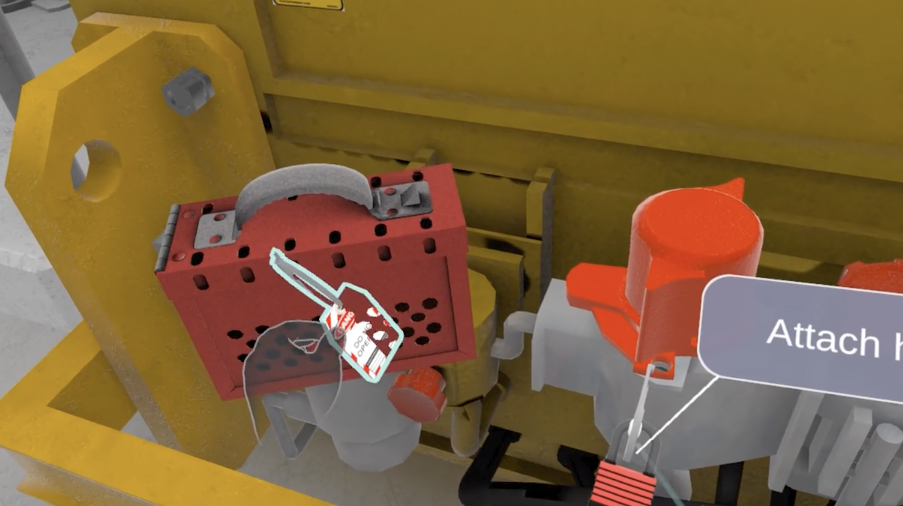
Lockout tagout is consistently among the most cited violations in manufacturing, and it’s a procedure that reads simply on paper and goes badly wrong in practice. We built an immersive lockout tagout program that takes learners through the full energy isolation sequence, from identifying every energy source through to verification before work begins.
A guided train mode walks through each stage with prompts, then an assessment mode removes the support and scores the learner on completing the isolation unassisted. Getting it wrong in the simulation is exactly the point, because it surfaces the steps people skip before they skip them on a live machine. The same program has since been deployed by other industrial clients including Kinross Gold.
4. Enel Green Power’s VR training for renewable energy technicians
- Company: Enel Green Power
- Sector: Renewable energy
- Training focus: Wind, solar, and substation maintenance
- VR developer: VR Vision
Renewable assets are spread across enormous geographies, and getting technicians to them for training burns time before anyone learns anything. Enel Green Power built VR training on digital twins of wind turbines, substations, and solar installations so technicians can walk a site and rehearse procedures like SF6 substation switching without leaving their base.
The program is targeting a 50% reduction in technician training time, with multiplayer sessions letting dispersed teams work through the same scenario together. For an operator running assets across multiple countries, that’s the difference between training people when it suits the schedule and training them when travel budgets allow.
5. Ford and Bosch’s VR training for electric vehicle technicians
- Company: Ford and Bosch
- Sector: Automotive
- Training focus: High-voltage electric vehicle service procedures
- VR developer: Bosch, on the PIXO VR platform
Launching the all-electric Mustang Mach-E created a training problem with no conventional solution. Technicians needed to be competent on a high-voltage system before dealerships had any physical vehicles to work on. Bosch built a VR training tool for the job, and Ford became the first automaker to put it into service.
Technicians could work through the high-voltage system, understand component locations, and rehearse service procedures on a car that didn’t yet exist in their workshop. For any manufacturer bringing new powertrain technology to market, that ability to train ahead of the hardware is worth as much as the training itself.
6. Hilton’s VR training for guest service
- Company: Hilton
- Sector: Hospitality
- Training focus: Guest service and customer interaction
- VR developer: SweetRush
Hilton has been working with SweetRush on immersive training for a decade, and the recent work combines VR with conversational AI. Trainees hold a spoken conversation with a digital guest, either through a headset or a browser, and the system evaluates how they handled the interaction before giving feedback on tone, wording, and resolution.
The efficiency gain has been substantial. A customer service fundamentals session that previously ran to four hours in a classroom now takes around 20 minutes as an immersive experience, which matters in an industry where turnover is high and every hour of training is an hour off the floor.
7. Johnson & Johnson’s VR training for surgeons
- Company: Johnson & Johnson
- Sector: Medical devices and healthcare
- Training focus: Orthopedic surgical technique and device implantation
- VR developer: Osso VR
The Johnson & Johnson Institute uses Osso VR to train surgeons on orthopedic procedures and device implantation, letting them rehearse a technique repeatedly before they ever perform it on a patient. It’s one of the few immersive training programs anywhere that has been put through controlled academic testing.
In a randomized trial run at UCLA’s David Geffen School of Medicine, participants trained in VR improved their overall surgical performance by 230% compared with a group that used standard technique guides. A later study on knee arthroplasty found VR-trained participants completed the procedure around 25% faster with fewer corrections along the way. In surgery, that combination of speed and precision is the whole game.
8. KiwiRail’s VR training for yard and locomotive operations
- Company: KiwiRail
- Sector: Rail
- Training focus: Yard operations and locomotive engineering
- VR developer: Nexefy
KiwiRail faced a constraint every rail operator recognizes. Locomotives and yard assets earn money when they’re moving freight and lose it when they’re tied up for training, which caps how much practical experience any trainee can get. Nexefy built VR modules covering 23 interactive activities across the Yard Operator and Locomotive Engineer programs.
Trainees now alternate between a real asset and a virtual one, and KiwiRail recorded a 25% increase in actual practical learning time as a result. The program was named a finalist for VR Enterprise Solution of the Year at the International VR Awards, and it solved the scheduling problem without taking a single locomotive out of service.
9. Lufthansa’s VR training for student pilots
- Company: Lufthansa Aviation Training
- Sector: Commercial aviation
- Training focus: Multi-engine flight training on the Diamond DA42
- VR developer: BRUNNER Elektronik, using Varjo hardware
In 2025 Lufthansa Aviation Training put BRUNNER’s NOVASIM MR into service, a mixed reality simulator replicating the Diamond DA42. It became the first mixed reality flight simulation training device to be qualified to EASA standards at FNPT II level, which is the milestone that changes everything about the business case.
Regulatory qualification means hours flown in the device count toward a pilot’s license rather than sitting outside the formal syllabus as extra practice. Lufthansa Aviation Training puts more than 700 pilots a year through its centers, and a qualified mixed reality device gives them training capacity at a fraction of the footprint and cost of a full flight simulator.
10. Mars Wrigley’s VR training for packaging operators
- Company: Mars Wrigley
- Sector: Food manufacturing
- Training focus: Packaging machine operation and changeover
- VR developer: Futurus
Mars Wrigley had a production problem with a training cause. Case fill rates had fallen into the mid-60% range against a target of 98%, and the bottleneck was how long it took to get new machine operators up to competency on the packaging line. They built VR training for three machines, a foil wrapper, an envelope packer, and a tray packer.
The numbers that came back are among the most specific published by any manufacturer. Training time was cut in half, output rose 45%, and 200 operators were onboarded within six months. Mars Wrigley put the total business impact at $19 million, including 200,000 additional cases of gum produced across a seven month period.
11. Nutrien Ag Solutions’ VR training for ammonia transfer
- Company: Nutrien Ag Solutions
- Sector: Agriculture and hazardous chemicals
- Training focus: Anhydrous ammonia transfer
- VR developer: SHIIFT
Anhydrous ammonia transfer is one of the highest-consequence routine tasks in agricultural retail, and it’s a procedure where a single missed step can put someone in hospital. We built Nutrien Ag Solutions a digital twin of a real transfer site so operators can rehearse the full sequence, which runs to more than 60 steps, with no exposure to the chemical.
The experience runs through a VR headset or as a web application, so thousands of operators across the network can access the same training at once regardless of what hardware their site has. Interaction data feeds straight back into Nutrien’s learning management system, which means competency is tracked against the actual procedure rather than a multiple choice quiz about it.
12. The Raymond Corporation’s VR training for forklift operators
- Company: The Raymond Corporation
- Sector: Material handling
- Training focus: Forklift and lift truck operation
- VR developer: FreeRangeXR
Raymond took an approach nobody else has matched. Rather than simulating the forklift, their Virtual Reality Simulator connects to a real one through a patent-pending port, so the operator sits in an actual cab, uses actual controls, and looks out at a virtual warehouse. The physical feedback is real because the truck is real.
The current generation runs on standalone headsets with more than 250 lessons covering operation, hazard awareness, and productivity technique. Research conducted through Raymond’s university research program found operator task completion times improved steadily across repeated VR training trials, which is the pattern you want before someone takes a loaded truck into a live aisle.
13. The RAF and Royal Navy’s VR training for fast jet pilots
- Company: Royal Air Force and Royal Navy
- Sector: Defense and aviation
- Training focus: Fast jet pilot training on the Hawk T2 and Texan
- VR developer: Ascent Flight Training and Lockheed Martin, using Varjo hardware
Under the UK Military Flying Training System, 11 training devices at RAF Valley have been upgraded with mixed reality for student pilots. Trainees see their own hands and the physical cockpit controls composited into a virtual world, which matters enormously in fast jet training where muscle memory and instrument scanning have to develop together.
The RAF expects the system to push more combat-ready pilots through to front-line squadrons each year while saving up to £4 million annually in training costs. The estate benefits are just as striking. The new devices take up between 10 and 20% of the floor space of the dome simulators they replace, and cost roughly a tenth as much to build.
14. Shell’s VR training for high-risk safety
- Company: Shell
- Sector: Energy
- Training focus: High-risk safety and the IOGP Life-Saving Rules
- VR developer: Pixaera
Shell needed high-risk safety training that worked the same way in Houston as it did in Lagos or Singapore. Working with Pixaera, they built a library of more than 30 immersive experiences mapped to the IOGP Life-Saving Rules, covering the hazards that account for the majority of serious incidents in oil and gas. Around 2,500 employees have been through the program worldwide.
The results speak to why immersive works for hazard recognition. After training, 97% of participants reported an improvement in their ability to spot unsafe acts and hazards, and 96% said the ability to fail safely in VR left them feeling better prepared for the real thing. The same content runs through headsets, in classrooms, and in a browser, which is how Shell got it to sites that will never have VR hardware on the shelf.
15. Skanska’s VR training for construction site safety
- Company: Skanska
- Sector: Construction
- Training focus: Construction site hazard awareness and safe behavior
- VR developer: OutHere
Skanska’s Step Into Safety program puts workers on a virtual construction site and lets them make the decisions that lead to an incident. Instead of being told what not to do, they do it, and watch what happens next. For a workforce that has sat through more toolbox talks than anyone can count, that shift in framing is the point.
Tania Sjöberg, the Skanska project manager behind the program, set the objective as behavioral change rather than knowledge transfer. The company wanted training that would fundamentally change how workers act on site, on the basis that most construction incidents involve people who already knew the rule they were breaking.
16. Thames Water’s VR training for wastewater crews
- Company: Thames Water & Lanes Group
- Sector: Water utilities
- Training focus: Wastewater network operations and crew coordination
- VR developer: SHIIFT Training, with IglooVision hardware
Thames Water and its wastewater network contractor Lanes Group wanted training that crews could go through together rather than individually. We built a custom multiplayer application for a 360-degree projection theatre, where a whole team stands inside a sewer network scenario on a cylindrical screen and talks through decisions out loud as they make them.
The shared format matters for work where the risk sits in communication between crew members rather than in any one person’s technique. The VR program won the Institute of Water Innovation Award for the South East region, and the first build was delivered in six weeks from brief to deployment.
The program later grew to cover roadside safety, including how a crew sets out cones to guard a work area on a live road. Get that layout wrong and the people you’ve put at risk are your own team, which makes it exactly the kind of task worth rehearsing in a virtual environment rather than reading about in a handbook.
The return on investment showed up in recruitment and retention rather than in training logistics alone. Thames Water and Lanes Group were losing skilled labor faster than they could replace it, and the immersive program was built to change that. It delivered a 57% increase in staff retention, a 10% increase in employee satisfaction, and $1.5 million in savings on recruitment and training costs. For a utility running thousands of field staff against a regulated cost base, keeping trained people is worth considerably more than shortening the course.
17. Toyota Material Handling’s VR training for service technicians
- Company: Toyota Material Handling
- Sector: Material handling and manufacturing
- Training focus: Forklift service, diagnostics, and parts identification
- VR developer: VR Vision
Toyota Material Handling deployed more than 300 headsets across its dealer network in the United States and Canada, training service technicians on parts identification and troubleshooting for electric forklifts. The program runs in three modes, covering guided procedural work, multiplayer sessions where technicians train together from different locations, and formal evaluation.
The operational case was about removing travel. Technicians previously had to be released to a central facility for hands-on training, which meant days away from customers and equipment sitting idle. Bringing the training to the dealership keeps technicians productive while they’re getting qualified on new models.
18. The US Air Force’s VR training for weather technicians
- Company: United States Air Force
- Sector: Defense
- Training focus: Mobile weather station and satellite terminal deployment
- VR developer: SHIIFT Training
Technical weather personnel have to be able to assemble, deploy, and troubleshoot a TMQ-53 mobile weather station and a BGAN satellite terminal in the field, often somewhere with no support and no second chance. We built a VR training experience around digital twins of both systems so airmen can reach competency without the equipment being physically present.
With the USAF VR training program, the equipment no longer has to be shipped to every location where personnel need to qualify on it, which removes the logistics bottleneck that used to dictate the training schedule.
That change is where the return on investment sits. The program saved the Air Force $2.5 million in its first six months of deployment. Every qualification that used to require physical hardware in the room meant transporting equipment, taking operational systems out of service, and moving instructors and airmen to wherever the kit happened to be. Replacing that with a digital twin removed the transport, the downtime, and the travel in one step, while putting more airmen through qualification in the same period.
19. UPS’s VR training for delivery drivers
- Company: UPS
- Sector: Logistics and transportation
- Training focus: Road hazard recognition for delivery drivers
- VR developer: In-house UPS technology team
Teaching delivery drivers to spot road hazards used to mean hours in a classroom describing situations they’d only recognize once they met them. UPS replaced that with a VR module at its Integrad training facilities, where trainees scan a virtual street scene and call out pedestrians, cyclists, parked cars, and anything else that could put them in an incident, while an instructor tracks their responses in real time.
Mark Gröb, who heads immersive technology at UPS, has said the change took that training block from eight hours down to two. That’s a 75% reduction on a program that runs thousands of drivers through it every year, and the trainees are more engaged for the two hours than they were for the eight.
20. Walmart’s VR training for store associates
- Company: Walmart
- Sector: Retail
- Training focus: Store operations, customer service, and new technology
- VR developer: STRIVR
Walmart’s rollout remains one of the largest VR training deployments ever attempted. After trialing the technology at its Walmart Academies, the retailer distributed more than 17,000 headsets across roughly 4,700 stores, putting immersive training in front of over a million associates. Modules covered everything from customer service and new technology to handling the crush of Black Friday.
Andy Trainor, who led Walmart US Academies at the time, reported that test scores improved by 10 to 15% for associates who went through VR training. The more interesting finding was that associates who simply watched a colleague go through a module saw similar retention gains, which changed how Walmart ran group sessions and stretched the value of every headset in the building.
What these programs have in common
Reading through 20 deployments, a few patterns repeat often enough to be worth pulling out. They also explain why the benefits of VR training show up so unevenly, with some organizations reporting cost savings and retention gains while others never get past a successful pilot.
- They start with a constraint, not a technology. Mars Wrigley had a case fill rate problem. KiwiRail was losing practical learning hours to asset availability. Ford needed technicians trained before the vehicles existed. In every case the constraint came first and VR was the answer to it.
- The best candidates are tasks you can’t safely practice. Ammonia transfer, energy isolation, high-voltage service work, fast jet handling, and orthopedic surgery all share the same characteristic, which is that the safest way to rehearse them is the way that doesn’t involve the real thing.
- The biggest savings come from what VR replaces. The Air Force stopped shipping equipment and saved $2.5 million in six months. Thames Water saved $1.5 million by holding onto people it was previously losing. The RAF replaced dome simulators that cost ten times as much to build. In each case the return on investment came from removing a physical dependency rather than from the training being marginally better.
- Delivery format follows the learning goal. Headsets suit individual procedural rehearsal. A shared 360-degree environment, as Thames Water found, suits crew scenarios where talking through the decision is part of the competency. Browser deployment reaches the people who’ll never have hardware in front of them.
- Measurement is designed in, not bolted on. The programs with the strongest numbers had a baseline before development started, which is the only way to calculate a real return on investment later. Data flowing into an LMS turns a training experience into evidence of competency, and gives you completion and retention figures an auditor or regulator will actually accept.
Conclusion
All these organizations are running immersive training as part of how they get their employees competent, and the companies measuring properly are seeing training times fall by half or more while retention and confidence go up. What’s changed since the early deployments is that the cost of the hardware has fallen far enough, the content is deployable across headsets and browsers, and the results have been repeated across enough sectors that nobody has to take the concept on faith.
If you’ve got a procedure that’s costing you time on the plant floor, tying up equipment, or putting people close to a hazard just so they can learn about it, that’s the one to look at first.