Send us a message
We would like to learn more about your challenges and to understand how we can support you.
Get in touch.
Send us a message and we’ll get
back to you within 48 hours.
Alternatively, email
hello@shiifttraining.com
All data used in this article is based on OSHA Frequently Cited Standards for NAICS 23 (October 2024 – September 2025)
These figures are subject to be changed by OSHA over time.
Construction is one of the most dangerous industries in the United States, and construction site hazards are among the most varied and severe any worker can face. Workers operate at height, handle heavy materials, use power tools and machinery, and move constantly between tasks and environments where conditions change by the hour. Federal OSHA issued 26,518 citations across 10,744 inspections in the construction sector between October 2024 and September 2025, generating over $110 million in penalties. That scale of enforcement reflects a sector where compliance failures are frequent and the consequences can be fatal.
The five most-cited standards below account for a significant share of that total, and each one points to a category of hazard that construction employers and workers encounter on virtually every job site. Understanding where OSHA focuses its enforcement, and why, is the first step toward addressing the gaps that lead to serious injuries and deaths.
OSHA Standard 1926.0501 – Duty to Have Fall Protection
6,750 citations | 6,613 inspections | $45,191,243 in penalties
Fall protection is, by a considerable margin, the most cited standard in construction, and it has held that position for years. Standard 1926.501 requires employers to provide fall protection for workers exposed to falls of six feet or more in general construction operations. This includes guardrail systems, safety net systems, and personal fall arrest systems.
The sheer volume of citations reflects how pervasive the exposure is. Roofing, framing, concrete work, steel erection, and demolition all involve working at elevation, often under time pressure and with crews that turn over frequently. When fall protection measures aren’t in place, or aren’t in place for every worker at every moment of exposure, the risk is immediate.
Falls remain the leading cause of death in construction. The $45 million in penalties issued under this standard in a single year demonstrates both the frequency of violations and OSHA’s willingness to pursue significant penalties where fall protection is absent or inadequate.
For construction companies looking to close this gap, immersive training methods have shown strong results in building the kind of consistent, practiced behavior that keeps workers protected. SHIIFT’s Working at Height VR training was developed specifically for construction environments and teaches life-saving rules around fall hazards in a safe, off-site simulation, capturing performance data that HSE supervisors can use to target retraining.
OSHA Standard 1926.1053 – Ladders
2,752 citations | 2,382 inspections | $9,620,629 in penalties
Ladder violations are the second most cited standard in construction and account for nearly $9.6 million in penalties. Standard 1926.1053 covers the safe use of portable ladders on construction sites, including requirements for the angle of use, securing at the top and bottom, maintaining three points of contact, and ensuring ladders extend at least three feet above the landing point.
Ladders are among the most routinely misused pieces of equipment on any job site. Workers often treat them as a quick solution rather than a piece of equipment with specific safety requirements. Common violations include ladders positioned at the wrong angle, ladders used to access upper levels without being secured, and workers carrying materials while climbing.
The frequency of citations under this standard suggests that ladder safety isn’t being reinforced effectively through traditional training. Workers may know the rules in a classroom setting but don’t apply them consistently under the pressures of a busy job site.
OSHA Standard 1926.0451 – General Requirements
2,160 citations | 1,089 inspections | $7,798,574 in penalties
Scaffolding falls under the broader fall protection picture, but the general requirements standard for scaffolding is cited in its own right across more than a thousand inspections. Standard 1926.451 covers the design, construction, and use of scaffolding, including load capacity, plank integrity, guardrail installation, and access requirements.
Scaffolding failures can be catastrophic. A poorly constructed or overloaded scaffold can collapse, and workers on upper levels have no meaningful protection when that happens. The standard requires that scaffolds be designed by a qualified person, built under the supervision of a competent person, and inspected before each work shift.
Violations under this standard often involve scaffolds that have been erected quickly without adequate oversight, platforms that lack proper planking or guardrails, or scaffolds that have been altered mid-project without inspection. The relatively high penalty total relative to the number of inspections reflects the severity with which OSHA treats these violations.
OSHA Standard 1926.0503 – Training Requirements
2,160 citations | 2,106 inspections | $4,641,568 in penalties
The fall protection training standard is cited at almost exactly the same rate as scaffolding general requirements, and the inspection count tells its own story: 2,106 inspections flagged a training deficiency. Standard 1926.503 requires that workers exposed to fall hazards be trained by a competent person before they begin work. That training must cover recognizing fall hazards and the procedures to minimize them.
The proximity of this standard to 1926.501 in the citation data is significant. It’s not simply that workers are unprotected, it’s that they often haven’t been properly trained on how to protect themselves. Employers who install guardrails or distribute harnesses without ensuring workers understand how and when to use them are still falling short of compliance.
Effective fall protection training isn’t a single session. Workers need to understand the specific hazards on the specific site they’re working, not just generic awareness. Construction companies working on complex or varied job sites have found that interactive, scenario-based training significantly improves the transfer of knowledge to on-site behavior.
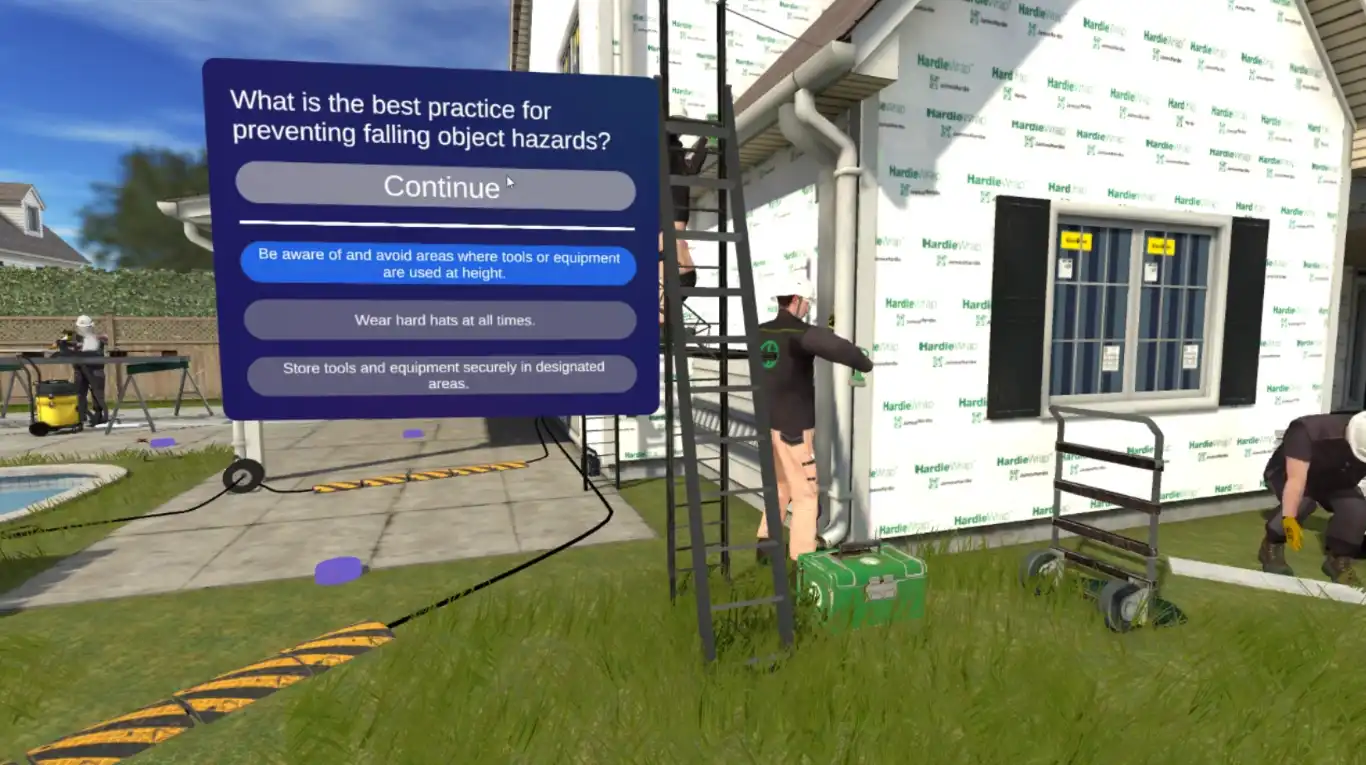
SHIIFT worked with James Hardie to develop an interactive 3D construction jobsite safety training simulation that puts workers in a realistic virtual job site to identify hazards and reinforce correct practices including fall protection. The program integrates with the client’s LMS, allowing supervisors to track individual performance and identify workers who need additional support before they face those hazards for real.
OSHA Standard 1926.0102 – Eye and Face Protection
1,921 citations | 1,918 inspections | $6,597,834 in penalties
Eye and face protection rounds out the top five, cited in nearly every inspection where it was examined. Standard 1926.102 requires that workers be provided with appropriate protective equipment when exposed to eye or face hazards from flying particles, molten metal, liquid chemicals, acids, caustic liquids, chemical gases or vapors, or injurious light radiation.
Construction generates a wide range of these hazards. Cutting, grinding, nailing, drilling, and working with chemical compounds all create exposure risks that require appropriate PPE. The near 1:1 ratio of citations to inspections suggests this isn’t a case of unusual or obscure hazards being missed, but rather a consistent failure to ensure workers are wearing the right protection during routine tasks.
PPE compliance requires more than making equipment available. Workers need to understand which tasks require eye and face protection, which type of protection is appropriate for different hazards, and how to use and maintain it correctly. When that understanding is lacking, the availability of equipment doesn’t translate into its use.
The citation data for NAICS 23 paints a consistent picture of the most common construction hazards: construction workers face serious, recurring hazards that aren’t being addressed effectively through conventional compliance and training approaches. Four of the five most-cited standards relate directly to falls, the leading cause of construction fatalities, and the fifth reflects a broader failure to ensure workers are protected during the tasks they perform every day.
Reducing citations and, more importantly, reducing injuries requires training that changes behavior on the job site, not just awareness in a classroom. Modern training methods, including immersive simulations, VR environments, and scenario-based eLearning, are demonstrably more effective at building the habits and decision-making skills that keep workers safe under real conditions.
SHIIFT is a specialist safety training production company creating immersive, interactive training solutions for high-risk industries including construction, energy, and manufacturing. From live-action and 3D animated safety videos to VR simulations and custom eLearning, SHIIFT produces content built for complex environments where training has to work. Whether you need engaging jobsite safety training or a fully immersive simulation for fall protection and working at height, SHIIFT has the capability to deliver it. Contact SHIIFT Training
Deliver next generation training. Get in touch.
Email us at hello@shiifttraining.com or send
us a message and we’ll be in touch within 48hrs.