Send us a message
We would like to learn more about your challenges and to understand how we can support you.
Get in touch.
Send us a message and we’ll get
back to you within 48 hours.
Alternatively, email
hello@shiifttraining.com
Virtual reality training has come a long way. What was once considered a novelty — something reserved for gaming or high-budget military simulations — is now being adopted by forward-thinking organisations across industries like oil and gas, construction, manufacturing, and healthcare. And yet, despite its proven track record, a number of persistent myths continue to hold companies back from making the switch.
It’s time to set the record straight.
This is perhaps the most common objection, and it’s understandable — the upfront perception of VR as a premium technology makes cost a natural concern. But the numbers tell a different story.
Traditional training programs carry significant recurring costs: instructor fees, travel, printed materials, facility hire, and lost productive hours. VR training, once developed, can be deployed repeatedly across an entire workforce with minimal additional expense. Research indicates that VR training reaches cost parity with classroom methods at 375 learners and becomes 52% more cost-effective with 3,000 learners.
A direct example: SHIIFT Training was retained by the United States Air Force to reduce the high costs of training personnel on the TMQ-53 weather station system. SHIIFT developed a VR technical weather training program using an immersive, interactive simulated environment — designed to replicate real-world weather station and broadband network operations — allowing trainees to practice troubleshooting and operational tasks virtually, without the need for physical equipment, which reduced both travel and logistical costs.

(U.S. Air Force photo by Paul Shirk)
$2,500,000
saved by the U.S. Air Force in the first six months alone
“When the final product was initially presented to the Air Force, they were stunned to see a tester complete the full physical process with ease after interacting with the physical equipment for the very first time — demonstrating the muscle memory gained from working within the VR environment.”
The real question isn’t whether VR training is affordable. It’s whether companies can afford not to invest in it.
There’s an assumption that VR headsets require a steep learning curve — that older workers or those less comfortable with technology will struggle to engage. In practice, the opposite is often true.
Modern VR training platforms are designed with usability at their core. Intuitive interfaces, guided onboarding, and straightforward controls mean that most users are comfortable within minutes of picking up a headset. The immersive nature of VR is, in many ways, more accessible than traditional classroom formats — it removes the pressure of being watched, allows learners to work at their own pace, and presents information in a way that is easier to retain.
96%
of participants had a positive or very positive view of VR for learning
Source: Deloitte
90%
felt comfortable during VR training, citing a safe, supportive environment
Source: Deloitte
88%
of participants wanted to use VR again for future learning
Source: ArborXR
4×
more focused than e-learning peers, 1.5× more than classroom learners
Source: PwC
Employee satisfaction by training method
Source: Accenture — retail associates trained with VR reported 30% higher employee satisfaction
That level of engagement isn’t what you’d expect from a technology workers find intimidating or hard to use.
No one is suggesting VR should replace hands-on field experience entirely. What it does, however, is prepare workers for that experience in ways that a classroom or a PowerPoint presentation simply cannot.
VR allows trainees to encounter high-risk scenarios — equipment failures, hazardous environments, emergency situations — in a completely safe and controlled setting. They can make mistakes, learn from them, and repeat the process without any real-world consequences. By the time they step into a live environment, they arrive with familiarity, confidence, and muscle memory that traditional training rarely delivers.
The Air Force example above illustrates this clearly. A tester with no prior hands-on contact with the TMQ-53 was able to complete the full physical assembly process accurately — because the VR programs had already built the competence. The real-world experience wasn’t bypassed. It was supercharged.
“The training situation was so realistic that I felt I was training on a real person in a real environment. I strongly believe that this will supplement today’s traditional training methods, and that it can enable more people to train more often.”
Anne Kristin Ihle Melby, Norwegian Directorate of Health – Source: Immersive Learning News
Some decision-makers worry that VR training produces outcomes that are difficult to track or report on. This simply isn’t accurate.
Quality VR training platforms come with built-in analytics that capture detailed data on learner performance — completion rates, response times, decision-making under pressure, areas of repeated error, and more. This level of insight is something traditional training methods rarely offer.
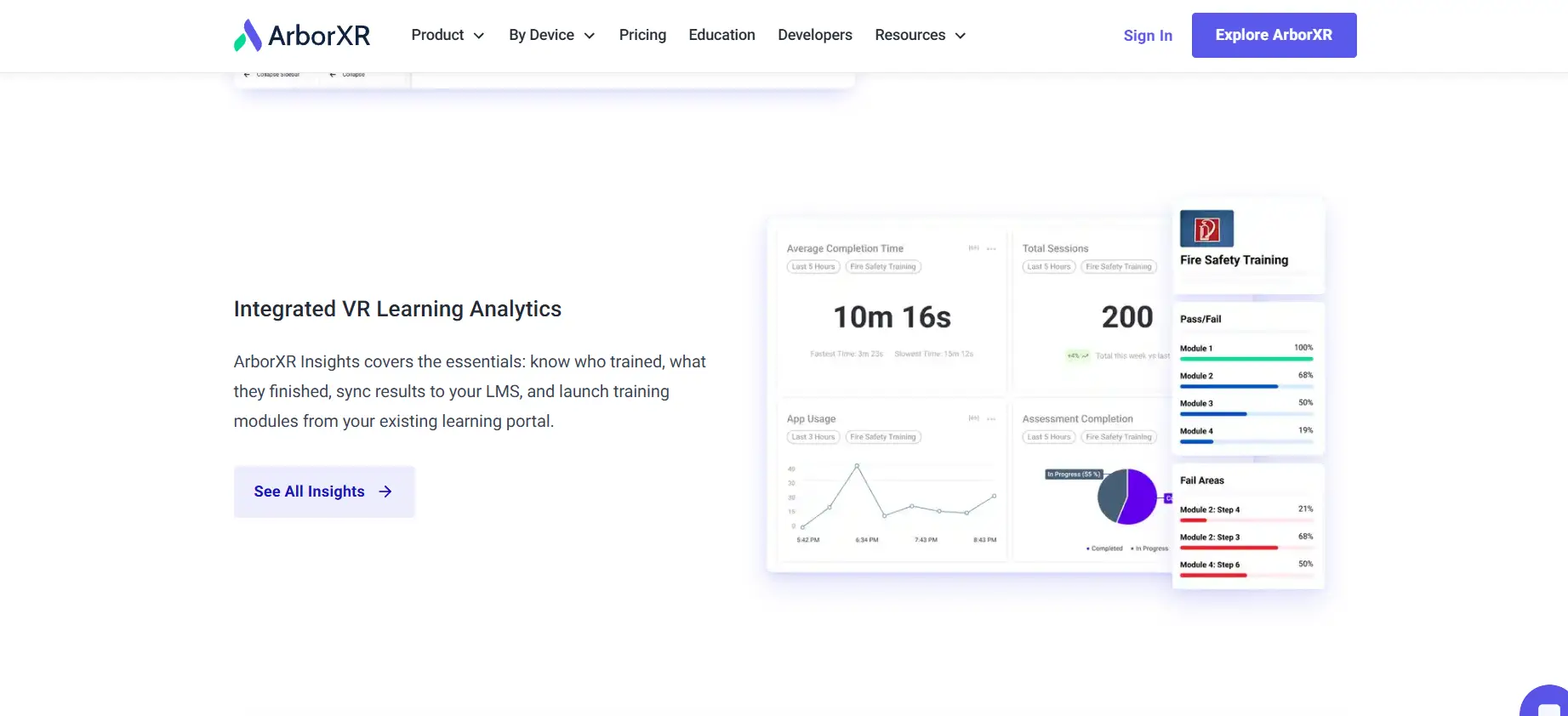
ArborXR’s website on measurable VR analytics
ArborXR, the leading enterprise XR device management platform trusted by over 3,000 organisations including 60+ Fortune 500 companies, has built its entire platform around making VR training measurable. ArborXR Insights uses built-in dashboards to measure learner outcomes and device performance, with the ability to stream raw data into external BI tools and push results into 500+ LMS, BI, and HR systems automatically. Performance metrics track outcomes through completion rates, app usage, error rates, and response times — revealing how well users learn and perform tasks in VR, and enabling targeted improvements.
Real-world results — measured
5,000%
increase in daily training capacity — Delta Air Lines went from 3 technicians per day to over 150
75%
reduction in training time — UPS moved from 8 hours to 2 hours per driver, without sacrificing effectiveness
Source: ArborXR
These outcomes weren’t estimated — they were measured.
Perhaps the most dismissive myth of all. VR training is sometimes perceived as a flashy add-on — impressive in a demonstration but lacking in real substance or long-term value.
Research consistently challenges this. The data on knowledge retention alone is striking:
80%
knowledge retained after 1 year with VR vs rapid fade with traditional training
Accenture & PwC
76%
increase in learning effectiveness over traditional methods
G2 / multiple studies
275%
more confident in applying new skills on the job after VR training
PwC study
Knowledge retained over time — VR vs traditional training
Source: Accenture & PwC — employees forget up to 90% of traditional training content within a month
3.75×
more emotionally connected to training content vs classroom learners
PwC
45%
reduction in workplace injuries vs traditional training methods
University of Maryland Virtual Lab
43%
reduction in lost-time injury rates after VR safety training
ArborXR / QinetiQ mining case study
A comprehensive study by PwC — one of the most cited pieces of research in the field — found that VR learners completed training four times faster than classroom learners, felt 3.75 times more emotionally connected to the content, and were up to 275% more confident to act on what they learned. The full study is available on PwC’s website.
For peer-reviewed academic support, a study published in Scientific Reports (Nature) involving 200 industrial participants found that VR-based training surpasses traditional methods by increasing safety awareness by 30%, enhancing risk perception, and improving self-efficacy — with statistically significant differences confirmed across all measured indicators.
For safety-critical industries in particular, the stakes are real. A major energy company reduced workplace accidents by 75% after implementing VR training modules for safety procedures. That’s not a gimmick. That’s a measurable, documented transformation in workforce safety.
The myths surrounding VR training often stem from outdated perceptions or a general resistance to change. But organisations that have moved past those barriers are seeing real results — safer workforces, stronger compliance, and a training culture that actually resonates with employees.
VR training isn’t the future of workplace learning. For many leading organisations, it’s already the present.
Deliver next generation training. Get in touch.
Email us at hello@shiifttraining.com or send
us a message and we’ll be in touch within 48hrs.