Send us a message
We would like to learn more about your challenges and to understand how we can support you.
Get in touch.
Send us a message and we’ll get
back to you within 48 hours.
Alternatively, email
hello@shiifttraining.com
Almost two workers die in confined spaces every week in the United States.[1] Every one of those deaths is preventable. Every one also sets off a chain of financial and legal consequences that can devastate even large, well-resourced businesses.
When organizations evaluate confined space training budgets, they typically look at the cost of the training itself. Rarely do they calculate the cost of getting it wrong. This post breaks down what a confined space incident actually costs your business — and why the numbers make a compelling case for investing in better, more immersive training.
Estimated total cost to a business following a single confined space fatality (OSHA)
Sources: OSHA, NIOSH/CDC, Bureau of Labor Statistics. Cost ranges are estimates; individual cases vary.
OSHA defines a confined space under 29 CFR 1910.146 as any space large enough for a worker to enter, with limited means of entry and exit, and not designed for continuous occupancy. Examples include storage tanks, silos, manholes, tunnels, ship holds, process vessels, and certain pipelines.
OSHA further distinguishes “permit-required confined spaces” — those that contain or have the potential to contain a hazardous atmosphere, engulfment risk, or other serious safety hazards. It’s these spaces where the most serious incidents occur, and where compliance requirements are most stringent.
The hazards aren’t always visible. Toxic gases accumulate without warning. Oxygen levels can drop to dangerous levels within minutes. Workers have lost consciousness and died shortly after entering spaces that appeared completely safe. And critically, according to NIOSH, more than 60% of confined space fatalities involve would-be rescuers — coworkers who entered without proper equipment or training in an attempt to help.[2] A single incident can quickly become a multiple-fatality event.
According to data from the Bureau of Labor Statistics Census of Fatal Occupational Injuries, there are approximately 129 fatalities in confined spaces per year in the US — nearly two per week.[1] These aren’t abstract statistics. Behind each number is a business that faced regulatory investigation and civil litigation. In most cases, the incident could have been prevented with better training.
Key figures at a glance:
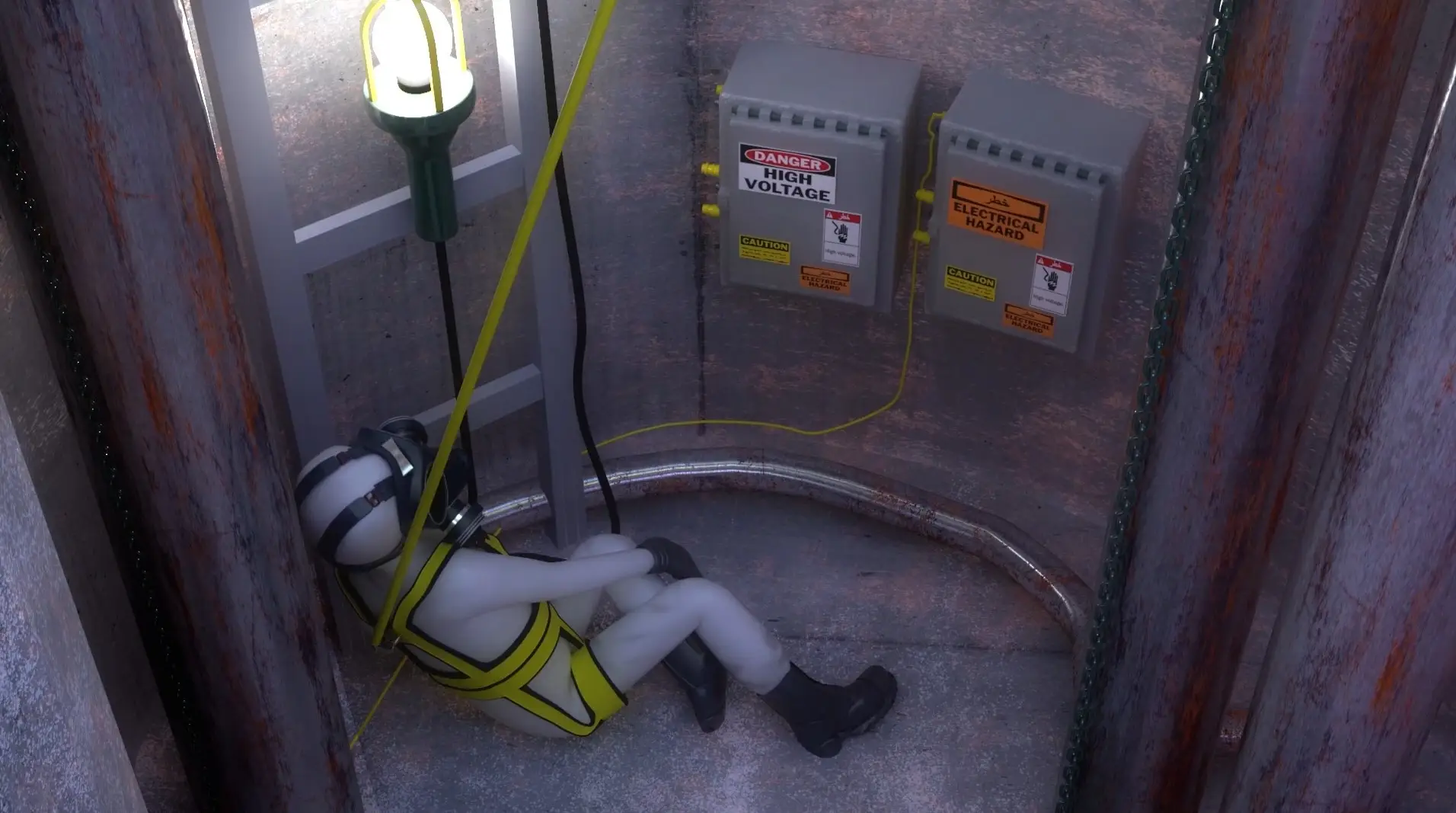
Collapsed confined space worker from ADSSC video
OSHA can issue serious violations for confined space safety failures, with penalties reaching up to $16,550 per violation and up to $165,514 for willful or repeated violations.[4] In multi-fatality incidents, penalties stack quickly. A June 2009 triple fatality at a Queens, NY recycling facility — where a worker was overcome by hydrogen sulfide gas in a dry well and two would-be rescuers also died — resulted in combined fines of $1.32 million issued against two employers.[5]
It’s also worth noting that having written procedures on file is not enough. As OSHA makes clear, employers are responsible for the safety of all workers — regular, temporary, and contract — regardless of whether an individual employee disregarded those procedures.[6]
Many employers underestimate what a confined space incident triggers operationally. Here is what typically happens from the moment an incident is reported.
Initial incident response: Employers must report a fatality to OSHA within 8 hours — from that point a formal investigation is mandatory. In serious cases an OSHA compliance officer may arrive on site within days. The immediate incident area is typically secured — no equipment moved, no cleanup until OSHA clears it — and management attention shifts entirely from running the business to managing the investigation.
The inspection phase: OSHA investigators will interview witnesses, review training records, inspect equipment, examine permits to work, and assess whether your confined space program meets 29 CFR 1910.146 in full. Any gaps — incomplete atmospheric testing records, missing attendant logs, untrained workers — become evidence of non-compliance. Even if your procedures are mostly sound, a single documented lapse can support a serious violation citation.
Citations and the contest period: Once OSHA issues citations, employers have exactly 15 working days to contest them in writing — a deadline confirmed directly in OSHA’s own regulations under 29 CFR 1903.17.[7] Miss that window and the citation becomes a final order — not subject to review by any court or agency. Most employers engage legal counsel at this point, adding attorney fees on top of the penalties themselves.
Abatement requirements: Alongside fines, OSHA mandates corrective actions — updated procedures, retraining, new equipment — with specific deadlines. Failure to abate within those deadlines carries additional daily penalties of more than $12,500 per day.[8]
Beyond OSHA fines, businesses face civil litigation from the families of injured or deceased workers. Jury awards in workplace fatality cases have grown significantly in recent years, with juries increasingly signaling that they view safety failures as inexcusable. Legal costs — attorneys, expert witnesses, depositions, court time — can run into hundreds of thousands of dollars before any settlement or judgment is reached.
OSHA estimates the average total cost of a confined space fatality to a company at $1.6 million, accounting for fines, legal fees, compensation, and lost productivity.[3] For small and mid-sized businesses, a single fatality can mean bankruptcy.
When a confined space fatality occurs, the immediate incident area is secured pending OSHA investigation — no equipment moved, no cleanup until cleared. Depending on the site and circumstances, broader operations may also be affected, and management attention shifts rapidly from day-to-day operations to the investigation itself. The financial impact compounds rapidly:
OSHA inspection results and enforcement actions are publicly searchable. Industry trade press covers major incidents. Clients and partners conduct due diligence. A high-profile confined space fatality can cost you contracts you’ll never know you were considered for, damage recruitment, and undermine confidence in your operations across the board. In industries like oil and gas, utilities, construction, and water treatment — where confined space work is routine and clients are large, risk-conscious organizations — reputational damage from an incident can be existential.
Following a serious incident, your employer’s liability and workers’ compensation insurance premiums will rise. The uninsured costs of accidents typically far exceed any premiums paid, meaning the full financial exposure of a single serious incident dwarfs what most companies have budgeted for risk management.
An OSHA investigation can run for months, absorbing significant management bandwidth. Meanwhile, workforce morale takes a serious hit — particularly among those who worked alongside the victim or who routinely work in confined spaces themselves. Lower morale translates to lower productivity, higher absenteeism, and higher turnover, all of which carry their own costs.
Confined space hazards don’t look the same across every industry. The financial exposure varies significantly depending on the sector, the nature of the spaces involved, and the regulatory scrutiny each industry faces.
Construction sites contain some of the most varied confined space hazards of any sector — excavations, trenches, utility tunnels, and partially completed structures all qualify. The construction workforce is also more transient than most, meaning confined space training delivered to one crew may not carry over when that crew moves to a new site or is replaced. OSHA data consistently shows construction among the highest-risk sectors for confined space fatalities, and the industry’s complex subcontracting structures can create confusion over who is responsible for ensuring compliance.
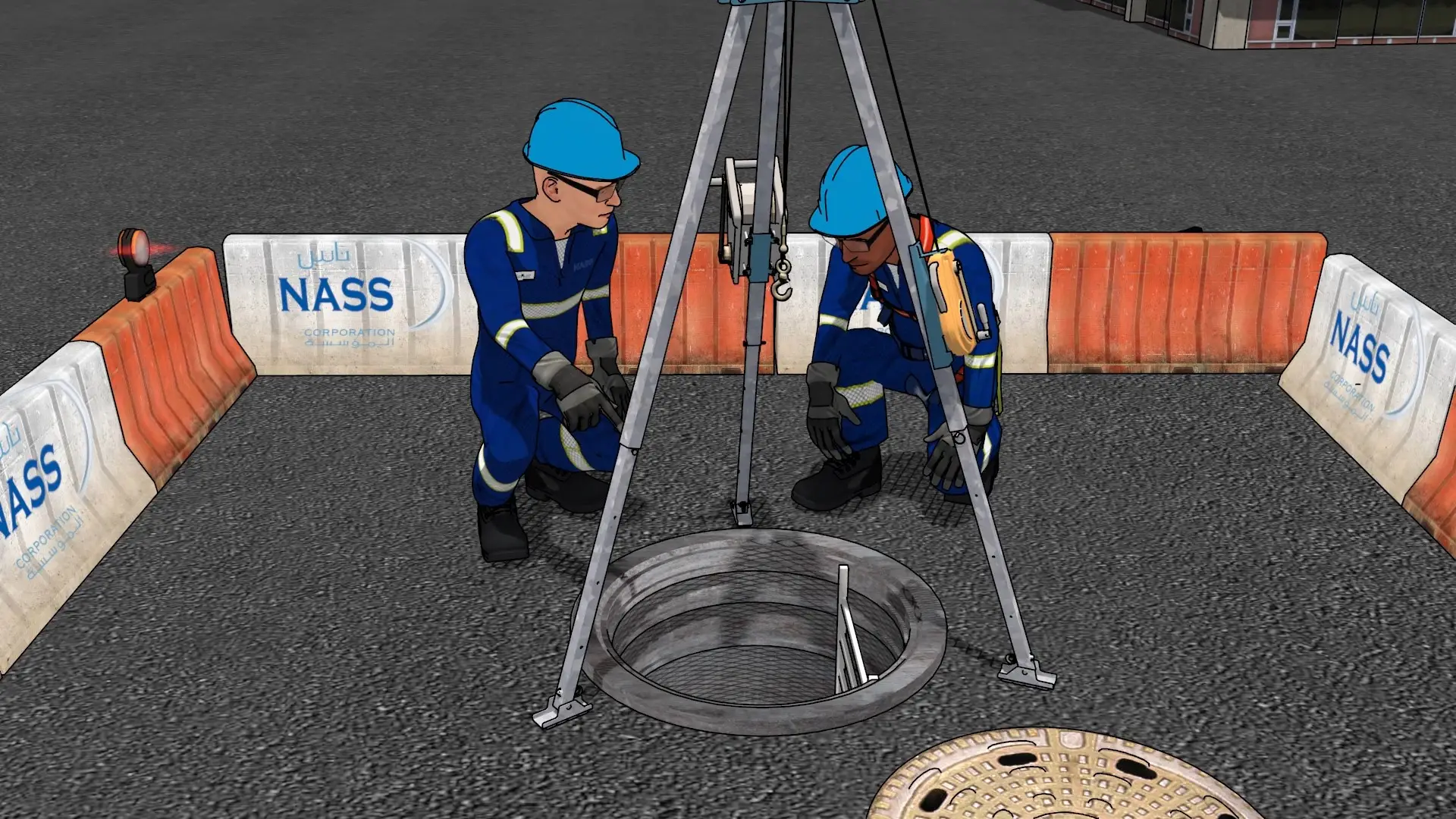
Snapshot from a 3D HSE Induction video we created for Nass Corp
Confined space work in oil and gas — storage tanks, process vessels, pipelines, drilling equipment — carries some of the highest fatality risks of any sector. Hydrocarbon vapors, hydrogen sulfide, and oxygen-deficient atmospheres can incapacitate a worker within seconds. The sector is also one of OSHA’s most heavily scrutinized, with process safety management (PSM) regulations layering additional compliance requirements on top of the standard confined space rules. A single fatality in an oil and gas facility can trigger a PSM audit that exposes the entire site to additional violations and fines far beyond the confined space incident itself.
Sewer systems and wastewater treatment facilities present some of the most complex confined space hazards in any industry. Hydrogen sulfide — produced by decomposing organic matter — is odorless at dangerous concentrations and can cause immediate incapacitation. Methane creates explosion risks. And because sewer infrastructure is aging across much of the US, the frequency with which workers need to enter confined spaces for inspection and maintenance is only increasing. Utilities also face unique workforce pressures — high turnover, an aging skilled workforce, and the challenge of training new recruits quickly without compromising on safety.
Large-scale manufacturing and chemical processing facilities typically contain numerous permit-required confined spaces — reactors, storage tanks, mixing vessels, and more. The chemical hazards involved are often highly site-specific, requiring training that reflects the actual substances and processes workers will encounter, not generic hazard awareness. A training program that works for a food processing plant may be wholly inadequate for a chemical refinery. The cost of a single incident in these environments — particularly where hazardous substances trigger environmental response obligations on top of OSHA requirements — can be catastrophic.
OSHA data and NIOSH investigations indicate that proper training could prevent the vast majority of confined space fatalities. Yet NIOSH found that in incidents it investigated, only 15% of participants had received any confined space training at all — and not a single incident had a prepared rescue plan or pre-entry atmospheric testing in place.[9]
The problem isn’t always that no training exists. It’s often that the training isn’t adequate for the actual conditions workers face. Generic e-learning modules and classroom instruction struggle to build the instinctive, procedural knowledge that workers need in a real confined space under pressure. When oxygen levels begin to drop inside a storage tank or sewer, the time available to make the right decision is measured in seconds. That kind of response has to be trained into the body — not just understood intellectually.
This is the fundamental limitation of conventional confined space training, and it’s where immersive training changes the picture.
At SHIIFT, we build confined space training experiences that place workers inside realistic, high-fidelity hazardous environments — without any of the real-world risk. Depending on the client’s needs and infrastructure, we deliver this through VR simulation, shared immersive environments, or 3D animated safety video — each approach tailored to the workforce, the hazard, and the desired training outcome.
The research on immersive training outcomes is consistent. VR learners retain knowledge at a 76% higher rate than those trained through conventional classroom methods, and their confidence to act on what they’ve learned increases by 275%.[10] The ability to build the kind of procedural muscle memory that matters in an emergency simply doesn’t exist in theoretical or lecture-based training.
Abu Dhabi Sewerage Services Company (ADSSC), now rebranded as TAQA Water Solutions, manages large-scale sewerage infrastructure where confined space hazards are frequent, high-risk, and often misunderstood by the workforce.
SHIIFT was commissioned to produce a fully 3D animated confined space safety video tailored to ADSSC’s operational environment. The animation walks workers through the specific hazards they face — toxic and flammable gases, oxygen deficiency, engulfment, electrical dangers, and restricted movement — using character animation and dynamic 3D visuals tied directly to tasks ADSSC employees perform every day.
Thames Water, one of the UK’s largest water utilities, came to SHIIFT with a workforce challenge common across the utilities sector — high turnover, recruitment pressure, and training that wasn’t delivering the outcomes they needed for workers operating in some of the most hazardous environments in the industry, including sewer maintenance and fatberg removal.
SHIIFT developed immersive training programs for Thames Water and their partner Lanes Group plc, including a custom-built application using an Igloo 360° VR facility — a shared, headset-free virtual environment where teams could train together in realistic, interactive scenarios. The solution also won Thames Water and Lanes Group the Institute of Water Innovation Award 2020 for the South East Region.
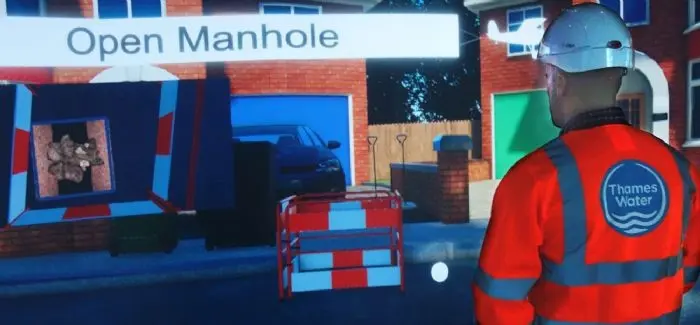
As part of a broader program of initiatives, Thames Water reported remarkable results:
When the alternative is a confined space fatality costing an average of $1.6 million in direct costs alone — before reputational and insurance impacts — the investment case for better, more immersive training is not a difficult one to make.
If you operate facilities where workers enter confined spaces — whether in oil and gas, utilities, water treatment, construction, or manufacturing — the question isn’t whether to take confined space training seriously. OSHA regulations under 29 CFR 1910.146 already answer that. The question is whether your current training is genuinely fit for the risk your workers face.
If any of those questions give you pause, it may be time for a conversation.
SHIIFT creates immersive VR, simulation, and animation-based safety training for high-risk industries across the US, UK, and Middle East.
If you’d like to discuss how we can help improve confined space training outcomes at your organization, get in touch.
Deliver next generation training. Get in touch.
Email us at hello@shiifttraining.com or send
us a message and we’ll be in touch within 48hrs.