Send us a message
We would like to learn more about your challenges and to understand how we can support you.
Get in touch.
Send us a message and we’ll get
back to you within 48 hours.
Alternatively, email
hello@shiifttraining.com
"*" indicates required fields
Virtual reality training is becoming an increasingly common part of corporate learning strategies. Organizations across industries are using VR to simulate real working environments, allow employees to practice complex procedures, and safely train for situations that would be dangerous or costly to recreate in the real world.
However, simply introducing VR into a training program does not automatically guarantee strong results. Like any training investment, the value of VR depends on how well it is designed, implemented , and integrated into existing learning systems.
By focusing on the right objectives, selecting suitable training scenarios, and deploying the technology effectively, organizations can significantly increase the return on their VR training investment.
The most effective VR training programs begin with clearly defined goals. Instead of starting with the technology itself, organizations should first identify the specific skills or knowledge gaps they want to address.
For example, a company may want to improve compliance with safety procedures, reduce operational errors, or shorten the time required to train new employees. These objectives should guide the design of the VR experience.
Clearly defined training outcomes also make it easier to measure whether the VR program is achieving its intended results. Metrics such as competency improvements, reduced training time, or fewer workplace incidents can all help determine the effectiveness of the investment.
Not every type of training benefits equally from virtual reality. VR delivers the greatest value in situations where traditional training methods struggle to replicate real conditions.
This often includes environments that are hazardous, complex, or difficult to access during training. For example, VR can simulate dangerous work environments, allow employees to practice emergency procedures, or demonstrate how to operate complex equipment without interrupting real operations.
Selecting the right scenarios ensures that VR is used where it provides the greatest learning or cost advantage.
By focusing on the most suitable use cases for VR training, organizations can maximize the effectiveness of their VR training programs.
VR training works best when it is combined with other learning methods rather than used in isolation. A blended approach allows organizations to take advantage of different formats for different types of learning.
For example, employees may first learn the theoretical aspects of a procedure through classroom instruction, eLearning modules, or instructional videos. VR can then provide an opportunity to apply that knowledge through hands on practice in a simulated environment.
This combination reinforces learning and improves retention. Employees can first understand the procedure conceptually and then experience it in a realistic scenario before performing it in the real workplace.
Selecting a VR training provider should be based on how well they can deliver outcomes, not just visuals or technology.
Start by assessing a provider across a few key areas:
It is important to review multiple providers and compare how they approach these areas. Many solutions may appear similar at a surface level, but differ significantly in depth, usability, and measurable impact.
SHIIFT is positioned as a strong option in this space, particularly for organizations operating in high-risk or process-driven environments.
SHIIFT focuses on scenario-based, high-fidelity training designed to replicate real tasks and workin
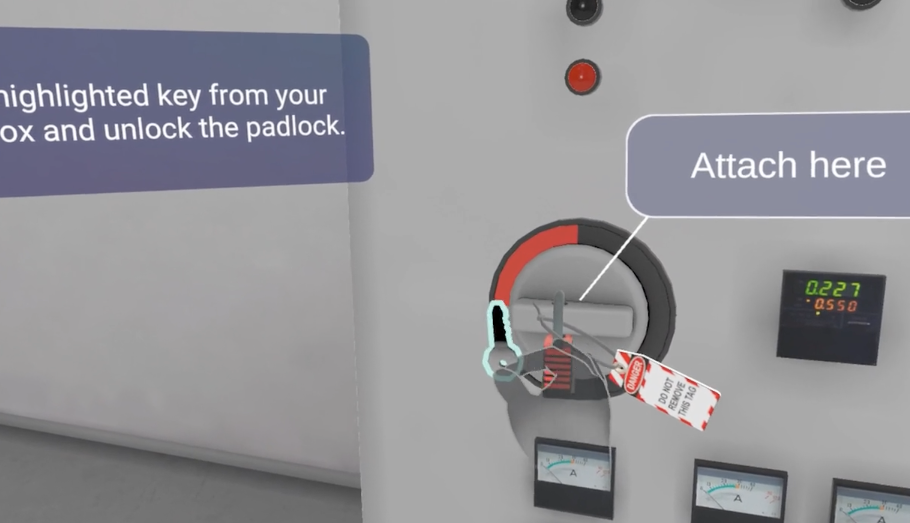
Snapshot of SHIIFT instructional VR on Lockout Tagout process
The strength of SHIIFT Training lies in its emphasis on behavioural accuracy. Training scenarios are built to reflect how tasks are actually performed, allowing users to practice decisions and actions in context rather than simply consuming information.
If you’d like to review options of VR solution providers, this article goes in detail on the top providers of the VR training space, and covers each provider’s strength and expected cost.
One of the major advantages of VR training is the ability to capture detailed performance data. During a simulation, the system can track how users interact with the environment, what decisions they make, and how long it takes them to complete specific tasks.
Examples of useful data include task completion time, procedural mistakes, incorrect decisions, and the number of attempts required to successfully complete a scenario.
Training managers can use this information to identify skill gaps, improve training materials, and better understand where employees may need additional support. Over time, this data can also help refine the VR training program and make it more effective.
To fully understand the value of VR training, organizations should measure the outcomes of their training programs. Tracking performance metrics makes it possible to evaluate whether the investment is delivering measurable improvements.
These metrics may include reduced training time, improved competency assessments, fewer workplace incidents, or lower reliance on physical training environments.
By monitoring these indicators, organizations can clearly demonstrate the impact of VR training and justify further investment in immersive learning technologies.
Deliver next generation training. Get in touch.
Email us at hello@shiifttraining.com or send
us a message and we’ll be in touch within 48hrs.