Send us a message
We would like to learn more about your challenges and to understand how we can support you.
Get in touch.
Send us a message and we’ll get
back to you within 48 hours.
Alternatively, email
hello@shiifttraining.com
Workplace accidents happen for a lot of reasons, but inadequate training is near the top of the list. The National Safety Council’s Work to Zero initiative found that lack of training was a systemic risk factor in all 18 of the most hazardous workplace situations it identified.
That’s a problem the industry has known about for years. What’s changed is what’s now available to fix it.
Virtual Reality (VR) puts workers inside a simulated version of a hazardous environment before they ever set foot in the real thing, and the evidence suggests it works considerably better than a handout or a classroom session ever did.
This article covers why that is and what the real-world data shows.
The most obvious thing VR does for safety training is also the most important: it lets workers practice dangerous tasks without any actual danger. The same processes get memorized and the same muscle memory gets built, but a mistake in VR doesn’t cost anyone a limb. Workers are free to get things wrong, see the consequences play out virtually, and understand what they did and why it mattered, without anyone getting hurt.
Traditional training has a hard ceiling on realism. You can walk workers through a fire response procedure on a whiteboard, but you can’t light an actual fire to practice it. VR removes that ceiling. A worker can respond badly to a simulated chemical spill, feel the consequences of that bad response, and correct it on the next run. That feedback loop, available without real-world risk, is something no classroom can offer.
VR safety training lets workers train in potentially dangerous situations while staying in a physically safe location. Trainees can rehearse high-risk tasks, encounter all related hazards, and experience possible outcomes in a realistic environment, which builds their ability to recognize and respond to those hazards when it counts.
Nutrien Ag Solutions uses virtual reality to train their staff on the hazardous ammonia transfer process. Their process difficult to memorize due to its length and complexity, and any deviation from the standard procedure results in severe consequences.
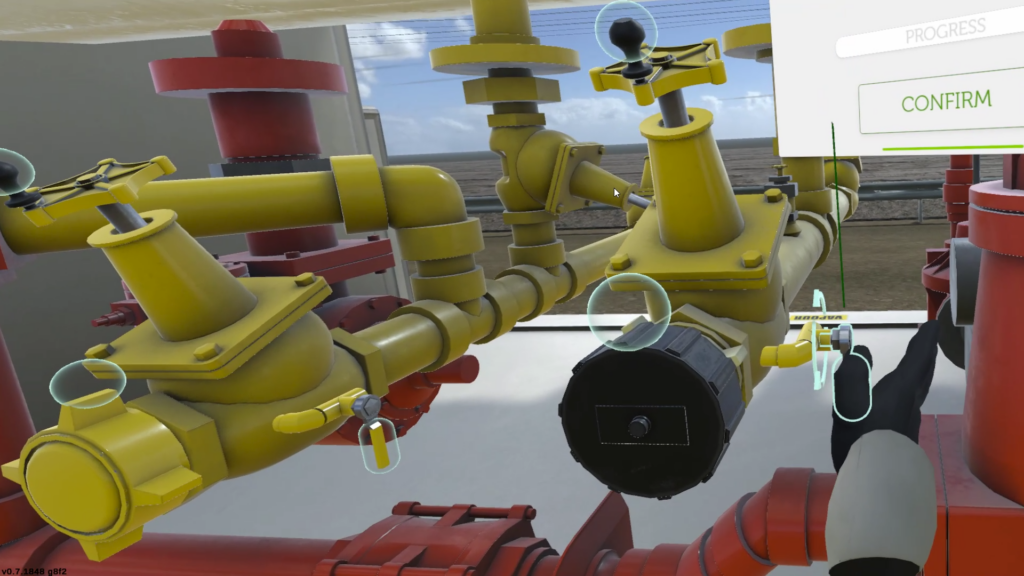
VR training scenario that lets users practice the ammonia transfer process, a hazardous gas which can kill if the procedure isn’t practiced safely.
A lot of workplace accidents come down to human error, and a lot of human error comes down to training that didn’t stick. Safety briefings have a well-earned reputation for going in one ear and out the other. Reading a procedures document or sitting through a slide deck asks very little of the person in the room, and the knowledge tends to reflect that.
VR asks more. When a worker physically navigates a virtual factory floor, spots a fault in a piece of equipment, and makes a decision about it, that experience gets encoded in memory differently than a bullet point on a page. The engagement is higher and the learning tends to last longer.
A VR training pilot run by Walmart and STRIVR found that employees who trained using VR scored higher on tests 70% of the time and saw a 10 to 15% higher rate of knowledge retention compared to before VR training was introduced. Walmart rolled the program out across nearly 4,700 stores across the United States on the back of those results.
A 2025 study published in Scientific Reports by Qawqzeh et al. tested this more formally. The researchers ran a quasi-experimental study with 200 industrial workers, split into a VR-trained group and a conventionally trained control group. The VR group showed a 30% improvement in safety awareness and statistically significant gains in risk perception and self-efficacy. Post-training assessment scores for the VR group rose from an average of 41 to 54, against a much smaller increase from 48 to 50.61 in the control group.
Some of the most important safety knowledge workers can have covers scenarios they’re unlikely to encounter on any normal working day, but that are catastrophic when they do. Oil rig explosions, large-scale chemical spills, structural collapses: these events are too dangerous and too rare to rehearse in the real world, but VR can replicate them with a level of fidelity no other training method comes close to. Workers can run through them repeatedly, building the kind of familiarity that makes the response feel automatic when it matters.
This also changes what hazard recognition training can do. Traditionally it’s been paper-based: printed worksheets where workers spot risks in a static diagram. Running that same exercise in a 3D environment you can physically explore, where hazards are animated and part of a live scene, produces a different level of learning. Workers develop recognition instincts, not just correct answers on a test.
Emergency response is one of the clearest fits for VR training. Trainees can practice responding to fires, chemical spills, and equipment failures without any real exposure to danger. The rarity of these events in everyday working life is what makes rehearsing them so valuable, and it’s also what makes conventional drills so limited. A quarterly fire drill doesn’t prepare someone for the genuine article the way repeated, realistic simulation does.
Every safety-critical industry does some version of hazard recognition training. For most, that’s meant paper exercises: spot the risk on a printed diagram, mark it, move on. In a fully explorable virtual environment where hazards are animated, contextual, and embedded in a realistic scene, the lesson lands very differently. Workers build genuine recognition instincts rather than just learning the right answers to a worksheet.
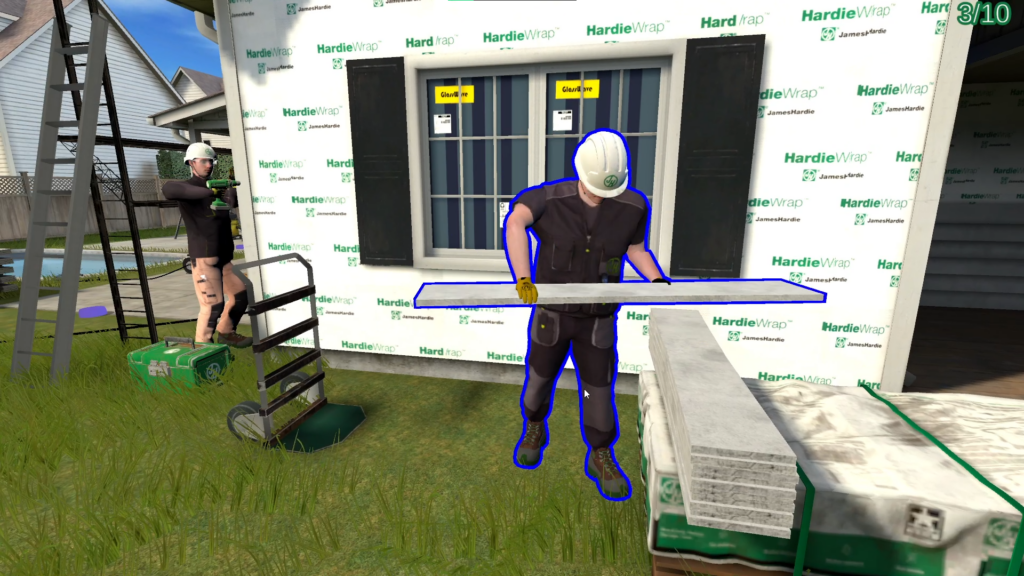
User finds a risk
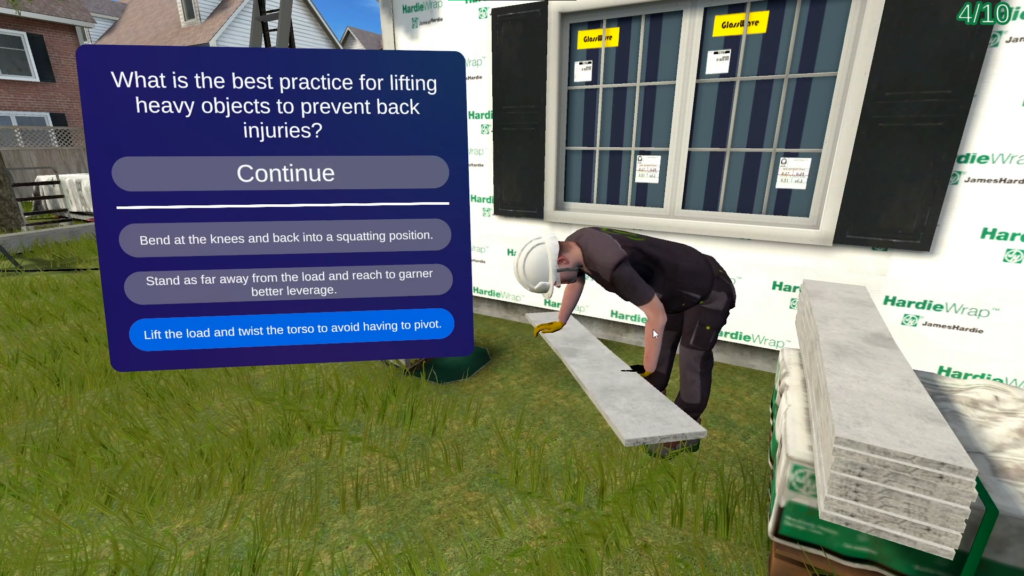
User then has to answer a question
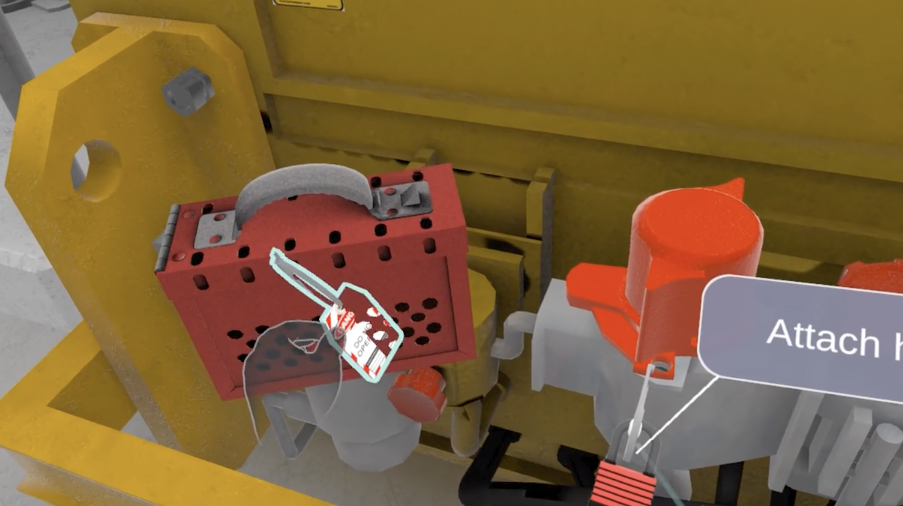
Hazardous lockout tagout process being practiced in virtual reality
VR lets workers get thoroughly familiar with complex machinery and multi-step procedures before they touch the real thing. There’s no risk to their safety, no disruption to live operations, and no risk of damage to equipment. Workers can make mistakes during the virtual familiarization, learn from each one, and arrive at the real machine prepared.
Nestle introduced VR into their training programs to address a gap that reading-based materials couldn’t close. According to the Nestle Global Safety Team, knowledge recall rates rose to 75% after the switch to VR, compared to 10% from reading materials alone. The company attributes the difference to VR’s ability to make workers actively engage with risks rather than passively read about them.
Pixaera partnered with Shell to deploy VR safety training aligned with the International Association of Oil and Gas Producers’ Life-Saving Rules. The rollout reached 2,500 employees globally across more than 30 high-risk scenario modules. After the training, 97% of employees reported improvement in their ability to spot unsafe acts and hazards and know how to intervene, and 96% said they felt safer as a result of being able to learn from mistakes in a risk-free environment.
Steven Wrobleski, Regional HSSE Manager for the Americas at Shell, put it plainly: “You learn best when you are allowed to do something and try something, rather than being told about something, and that’s a lightbulb that switched on in my mind.”
Trafigura found that traditional training programs at their service stations, terminals, and refineries couldn’t replicate the intensity of spills, fires, and equipment failures without putting participants at real risk or causing undue psychological stress. They introduced VR training as the solution. Following a three-month pilot of the VR program, every participant reported feeling safer, more confident, and better psychologically prepared for emergency response scenarios.
The Qawqzeh et al. study in Scientific Reports set out to measure how VR-based occupational safety training compares to conventional methods in an industrial setting. The researchers recruited 200 workers from manufacturing and production environments and divided them into two groups, one receiving VR training and one receiving traditional instruction. Both groups were assessed before and after training on safety knowledge, risk perception, self-efficacy, training effectiveness, and communication around safety protocols.
VR training was delivered across three 45-minute sessions over a week. Sessions covered emergency response simulations including fires and chemical spills, hazard identification in a virtual factory, and high-pressure decision-making scenarios. Statistical analysis using the Mann-Whitney U test and Wilcoxon signed-rank test confirmed that the VR-trained group significantly outperformed the control group across all measured outcomes. Risk awareness improved by 30% in the VR group, and training effectiveness scores were 30% higher than in the control group. The researchers concluded that VR reliably improves safety knowledge, risk perception, and worker confidence in industrial environments.
VR training reduces accidents because it gets at what actually causes them: workers who weren’t prepared for what they encountered. Reading materials and classroom sessions leave too much of that preparation undone. VR closes the gap by giving workers genuine experience of hazardous scenarios before those scenarios are real, and by building the kind of memory and instinct that holds up under pressure. The results from Nestle, Shell, and Trafigura, alongside peer-reviewed research, tell a consistent story.
Deliver next generation training. Get in touch.
Email us at hello@shiifttraining.com or send
us a message and we’ll be in touch within 48hrs.